Monday, June 2, 2014

Splintered by A.G. Howard


Synopsis: This stunning debut captures the grotesque madness of a mystical under-land, as well as a girl’s pangs of first love and independence. Alyssa Gardner hears the whispers of bugs and flowers—precisely the affliction that landed her mother in a mental hospital years before. This family curse stretches back to her ancestor Alice Liddell, the real-life inspiration for Lewis Carroll’s Alice’s Adventures in Wonderland. Alyssa might be crazy, but she manages to keep it together. For now.

When her mother’s mental health takes a turn for the worse, Alyssa learns that what she thought was fiction is based in terrifying reality. The real Wonderland is a place far darker and more twisted than Lewis Carroll ever let on. There, Alyssa must pass a series of tests, including draining an ocean of Alice’s tears, waking the slumbering tea party, and subduing a vicious bandersnatch, to fix Alice’s mistakes and save her family. She must also decide whom to trust: Jeb, her gorgeous best friend and secret crush, or the sexy but suspicious Morpheus, her guide through Wonderland, who may have dark motives of his own.

My thoughts: Whenever I say Alice, what do I think? White Rabbit wearing a blazer and late for tea, flowers that talk, butterflies with wings made of bread with butter, Queen of Hearts. But what if you find out that in fact the white rabbit was Rapid, a half skeleton with bug antennas instead of rabbit’s fluffy ears, that the flowers could eat you alive and had arms and their roots could get released from the ground so that they could chase you? And what if the Caterpillar or “Absolen” became a moth? Or worse… What if Alice wasn’t the real Alice?

                In this novel all this questions get answered. Alyssa was always bullied because of her roots: well, being the great-granddaughter of Alice Liddell, the inspiration for Alice in Wonderland by Lewis Carroll that was diagnosed as mad as the Mad Hatter isn’t something that she would be proud of. Because of the curse that the women descending from Alice have, they all end up in a hospice from real – and that’s what happened to Alyssa’s Mother. Now Alison is in great danger and Alyssa might be the only one able to find the rabbit’s hole and try to destroy the curse and save her mom. But it won’t be easy. Or most importantly… what if Alyssa actually belonged in Wonderland?

                This book gives you a very different view – as you can see from the top – of the original novel from Lewis Carroll. In this one, the descendent has challenges to defeat with her friend Jeb, who end up falling inside the rabbit’s hole with Alyssa, and with Morpheus, the Caterpillar – actually a moth now with human body, rock ‘n’ roll style with blue hair and a plan for Alyssa.

                I really liked this one! So much that if gave me a crave to read the original novel from Lewis Carroll – please don’t kill me I haven’t found time yet to read it. There were a few unnecessary part – (SPOILER) Like the fact that Alyssa has wings… I mean WHAT? (SPOILER) – but all-in-all it was very interesting and fun.

                Since this is the debut of the Author, I’ll say that I’m quite pleased with the results: good written novel, pleasant reading, with just a few parts over-the-top but nothing that would actually make me dislike the book.

                I really liked Jeb, and for a moment I thought that he had a relation with Wonderland as well as Alyssa because he really looked like the army from the White Queen – actually Ivory Queen in this novel – but he was human. He’s a sweet, loving, romantic and overprotective guy who has a crush for Alyssa but never told her because both of them are wrecked and filled with issues and he was afraid to pour it on her! *--*

                The other character that I liked was Morpheus, despite the fact of him being an asshole/cute/annoying/seductive bastard who also has a deep story with the main character. I was “Team Jeb” the whole time, but I gotta tell you that it wasn’t easy at all.

                The cover of the book is B-E-A-U-T-I-F-U-L and one of the main reason that I picked it in the first place – yes I judge a book by its cover. The mad way the girl looks at you is very mysterious and makes you think “curiouser and curiouser”.

Rate:

"The Unfinished Waltz" (translated from the portuguese title) by Catherine Clément


Synopsis (translated): They met in 1874. Sixty years later, in 1934, he had eighty-six years and only then knew the truth. Sixty years for a love that didn’t exist, but lasted an entire life.

                Nothing more than three dances, letters and a poem. He kissed her. She ran away. Sixty years of mystery and of daily basis, crossed by a winning capitalism and the first Bosnian War. The syphilis attacks Vienna, the refugees are everywhere, scandals too, suicides multiplies… E, during all this time, Elizabeth of Austria writes to Franz Taschnik, worker from the Ministery of International Affairs.

                Behind the Habsburg’s Europe, the Balkan’s War and The Vienna from Strauss, with an epidemic in the background, beyond the myth that is Elizabeth, the “Unfinished Waltz”, inspired by an authentic episode from Sissi’s life, shows in a magnificent way the painful happiness from forbidden loves.

My thoughts: Beautifully written! The romance was extremely delicate filled with real historical facts that made this book a joy to read. Empress Elizabeth was a misunderstood woman, ahead of her time that lost most of her life being a regent for a country that wasn’t your homeland and that never really liked her. One fateful night, she escapes from the palace, disguised in a costume for a ball and with her chaperone with her, and meet Franz Taschinik, who worked in the international bureau. He suspects that she might be the Empress, but if she was he would go to jail or worse, die, because of their dance, their flirting and their one kiss. Yes, one kiss, and they were in love for the rest of their life! Is there something more beautiful than this?

                Because of their encounter, they exchange a few letters, but they would never be able to be together because he was a nobody and she… well, she was the Empress! She couldn’t leave the Emperor… never, until death took them apart. So as time goes by, Franz continues with his life: marries, has kids, but never forgot about that one night with a girl named Gabriela, but that was actually the Regent Elizabeth.

                                Only when Franz is reeeally old and with a title – given to him as a wish of Who? Let’s see if you get correct – he finds out that the woman he has been looking all those years, that exchanged letters with her and everything else was IN FACT the Empress Elizabeth of Austria. Even though he got married, had kids and lived with his granddaughter, he never forgot her, in fact he kept the fan that he took from her at the ball.

                I really liked this book. Sometimes it was a little bit of a drag because things happened slowly than a usual historical book nowadays happens. But I really liked it nonetheless. Catherine Clément showed not only the romance, but what was happening in Europe: the prelude of a Great War, the suffering of many nations, especially the Jews, the decay of the Austrian-Hungary Empire. Her writing was pleasant and classic, at least for those who like romances filled with History.

                It’s not a tiring book, and it will never be. Despite all the odds, their love grew and was cherished by both of them, making this novel a joy and shock in a few scenes. One thing that I really liked was the search for the strange words in the book -  the Author was faithful until the end, using even native words from Hungary and Austria itself, giving me a hard time looking them up! ;P

Rate:
 and a half

Friday, January 17, 2014

The Hunger Games #1 by Suzanne Collins


Synopsis: Winning will make you famous. 
                Losing means certain death.


                In a dark vision of the near future, a terrifying reality TV show is taking place. Twelve boys and twelve girls are forced to appear in a live event called the Hunger Games. There is only one rule: kill or be killed.

                When sixteen-year-old Katniss Everdeen steps forward to take her sister's place in the games, she sees it as a death sentence. But Katniss has been close to death before. For her, survival is second nature.

My thoughts: It’s kind of complicated. Since I liked the movie, I thought that I would fall in love with the book, but that didn’t happen. The book is made of many short sentences in the present tense, with Katniss telling the story in first person. Even though I liked the strong character of her – a self-sufficient woman, helping herself and her family, being strong when her father died in the mines – the way the book was written was really poor! I mean, those short sentences made it look like a children’s book, all that was missing were the colorful pictures! And only by the end of it there was some real interaction between the couple. Since it’s a “teen’s” book, maybe the author should develop the text a little bit more in order to stimulate our young readers with texts a little bit more dense. That’s what I think.

                I thought that I would fall head over hills for Peeta, but I didn’t feel a thing. In fact, the only word that I think suits him is “cute”.  He is romantic and charming and stuff, but it didn’t get into me the way the characters from Throne of Glass did. As well as Gale, in contradiction with what I felt for them in the movies. At Rue's part it was specially sad, because seeing it again was really saddening, she was a kid with what? Maybe twelve years? Too young to die.

                When you read the book and see the movie, you get to see all the changes they had to do – Rue’s death, the leg that Peeta loses, the fact that the beasts at the end were the tributes, the Avox girl that never appeared on the big screen – but they didn’t made it too big so that you wouldn’t recognize it, but I have to say that I liked the movies more because you weren’t only in Katniss’s head all the time, you could see everyone else – from the other tributes to the game creators.

                Maybe I’m getting too old for this kind of book – it’s a young adult novel – or maybe I’m too demanding with my books, but I think that a Jane Austen’s novel or a Julia Quinn one or maybe a Melissa de la Cruz or a Meg Cabot would be better written than this one. I was kind of disappointed with it. If it weren’t for Katniss and her inner strength and because I thought that the end of the book was better than the end they made in the movie - even though I liked it too, but if it were to choose I would have chosen the book one - , this book wasn’t even going to get a three star. I’m planning to read the sequence because I’ve already started it and since I kind of liked the other movie, who knows? Maybe the second time is the trick.

Rate:

Thursday, January 16, 2014

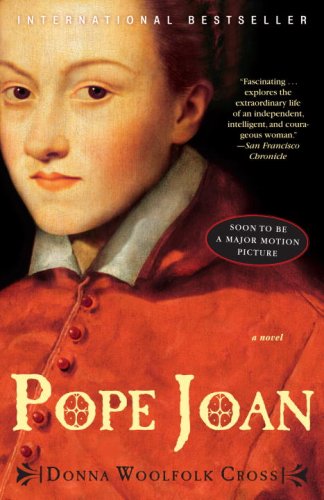
Pope Joan by Donna Woolfolk Cross


Synopsis: Pope Joan: A Novel, by Cross, Donna Woolfolk

My thoughts: oh, how I’ve wished for this book to be real! Not that I don’t believe in Johanna’s existence, on the contrary, but I wish that they didn’t erase all the data about her. I know this is a story made of fiction, but I want to believe that she existed. Why did they have to destroy all evidence of her just because of religion pride? Why didn’t they just hide it in the Vatican’s library in a private part that only a few knew how to find? So that those historical pieces weren’t lost?! How could they?

                Johanna was born at the same day that Carlos Magno died, January 28, 814 A.D. Hated by her father for being a woman but loved by her mother and older brother, little Johanna showed a great ability to write and read, better even than her middle brother Johannes. From that on, she showed not only those skills, but also the ability of argumentation and rhetoric, bringing her to the school of Dorstadt, where she was educated, something that for a woman in the beginning of the Middle Ages was unthinkable! However, she was bullied by her colleagues for her sex, forcing her to disguise her female characters with bandages and starting to behave like a man. When her brother Johannes was killed by Vikings, she took her chance and went for the monastery of Fulda under her brother’s name. That is just a few things that happened in the story, just to name you guys a few.

                Even though most of this was a fiction – like, how would someone (male, because female didn’t know how to write), in the Middle Ages, keep record of a girl’s childhood in a small village, as well as her life in a monastery as a man? – the more important historical facts were real. They can deny the existence of her, but I like to think that she existed.

                My only difficulties were with the vocabulary. The author used words related to the Vatican, such as the names of each person in the Vatican’s hierarchy, the names of the clothes the Pope’s used and the priests, making me go through the dictionary over and over, as well as looking for images at the Google. It was kind of a pain, but it is good to see how big and complex is the system of the Vatican, and there are still some words that I don’t know and never will! Another thing that was really hard for me was the Latin. Since I'm not used with the language at all, I had a hard time with it, but luckily they used to put the translated sentence right after so most of the time I could get by with it. Because of this details that were essential to the book but very difficult not just to me but I think that for many readers as well, I think that this book is more recommendable for some one well-studied or a professional like a theologist or something, but it was a great book nonetheless.

                I liked the ending, but it was a little unsatisfying. For me, a perfect ending was to see Anastacio’s execution because I don’t think that just being banned from Rome and not being able to get to his goods ever again isn’t a punishment good enough for what he did. For God’s sake, he tried to steal the Pope’s throne! Even though the Pope was dead already, it would be considered high treason and if it were the case, how could he eventually get to the librarian position? I think that they should have done his execution at public and when he was going to be punished he looked around and saw Johanna in her popery clothes and looking calmly to him. He then would have started screaming things like “witch” and “whore” and she would only move her lips and he would sooth down and dies. After all this scene, the author would right what Johanna said: “I forgive you, Anastacio, and welcome to the reins of Heaven.” The part of Arnalda could stay the same, because I liked it, but I think that this ending for Anastacio would be better than the one of him living until his eighties and something. Someone else could write the book.

Rate:

 and a half

Saturday, January 11, 2014

Sanditon and The Watsons: Austen's Unfinished Novels by Jane Austen


Synopsis: Praised by critics and studied by scholars, Jane Austen's novels endure because of their popularity with readers. The author's witty and astute observations elevate her tales of parties, gossip, and romance into matters of captivating drama, offering an evocative portrait of everyday life in the towns and countryside of Regency England. Austen's premature death at the age of forty-two curtailed her legacy, and her devotees have eagerly read and re-read her handful of books. This collection features two of her unfinished novels, an often overlooked pair of gems that enrich our appreciation of Austen’s storytelling gifts.


                These writings first appeared posthumously, when Austen's nephew included the texts in an 1871 memoir of his celebrated relative. The Watsons unfolds in a familiar domestic milieu, in which a spirited heroine finds her marriage opportunities narrowed by poverty and pride. In contrast, Sanditon ventures into markedly different territory. Set at a seaside resort, among a cast of hypochondriacs and speculators, it suggests that Austen's work might have taken some unexpected new directions. Even if these incomplete stories had been of little intrinsic value, they would have been of interest as literary records and curiosities. As it happens, they are of high quality and worthy of reading for their own sake, for pleasure as well as study.

My thoughts: I liked the first unfinished novel than the last, despite the fact that it was shorter. Lady Denham and Sir Edward Denham reminded me both of Lady Catherine and Mr. Collins from Pride and Prejudice, she was extremely conceited and he was talkative and idiotic, but Charlotte was a delight to read about. Her remarkable observations of her surroundings were very amusing. Diana, Susan and Arthur Parker were a funny trio too, because they seemed to want to be the best of the best, le crème de la crème, even though their “diseases” – because I agree with Ms. Heywood that most of them were fruits of their imagination – enabled them. In Sanditon, Jane Austen explored the satyr between health and sickness, and in The Watsons she was more concerned in talking about the debut ball of the girl Emma.

                I usually don’t talk about classics because if they weren’t good they would be called classics at all, but since this book was made of two unfinished novels of the author, I’ll just talk a little bit about it (one of them I already talked in the beginning).

                The Watsons were a delight, especially the little boy Charles that danced with Emma. He was so squeezable and sweet! (laughter) This novel in particular I wished Ms. Austen had finished it so I would know if Emma would marry Tom Musgrave, Lord Osbourne or Mr. Howard or even none of them and would stay like her older sister Elizabeth. I wanted to see Margaret suffer a little bit because I didn’t like her from the beginning. But it was so short! Jane why didn’t you finish it?! Sanditon you didn’t have to because the dialogues were to extensive to me, but I loved The Watsons!

                All in all, I really liked this glimpse of Jane, my favorite author of all times!

Rate:

Throne of Glass by Sarah J. Maas


Synopsis: After serving out a year of hard labor in the salt mines of Endovier for her crimes, 18-year-old assassin Celaena Sardothien is dragged before the Crown Prince. Prince Dorian offers her her freedom on one condition: she must act as his champion in a competition to find a new royal assassin. Her opponents are men-thieves and assassins and warriors from across the empire, each sponsored by a member of the king's council. If she beats her opponents in a series of eliminations, she'll serve the kingdom for three years and then be granted her freedom. 

                Celaena finds her training sessions with the captain of the guard, Westfall, challenging and exhilirating. But she's bored stiff by court life. Things get a little more interesting when the prince starts to show interest in her... but it's the gruff Captain Westfall who seems to understand her best. 

                Then one of the other contestants turns up dead... quickly followed by another. 

                Can Celaena figure out who the killer is before she becomes a victim? As the young assassin investigates, her search leads her to discover a greater destiny than she could possibly have imagined.

My thoughts: I’m in love. Seriously. Celaena got me! She is strong, fierce, sneaky, funny, adorable, foul mouthed and beautiful! I started less than four days ago and I’ve already finished! I don’t know what to say, I really don’t! She wasn’t afraid to take things on her own hands and make them work. She is different from every female character I’ve ever read because she didn’t sit there and waited, no; she made it happen. I couldn’t stop picturing Jennifer Lawrence as Celaena. I mean, they totally match! She would be awesome if it someday became a movie. Celaena is rule less, fearless and I like it.

                This book was well written. The author kept it simple but it was never tedious. Every chapter something happened, adding new details to this enticing story. Some parts were predictable to me, but it was delightful to see that I was right (I love when I get the things right! *laughs*). When I came to the end, I didn’t want to believe it. I wanted to tear it apart until I found some missing part that had the rest of the story. *laughs*

              The boys were amazing, but I have to say that I’m team Chaol (* ¬ *). Dorian was the hunk: the guys that get all girls, that is handsome, – his features are my favourite: blue eyes and black hair – rich, gentleman. But he is a kid: he’s nineteen, immature (for me), scared of his Father – the King of Adarlan. Chaol is different: despite the toughness, he is softhearted, funny, friendly. He stayed beside Celaena during all her preparation for the battle, and what did Dorian do?? Just came to her chambers once in a while and hooked up with her. Chaol, if Celaena doesn’t pick you, you can stay with me, no prob! *laughs*

                At first I thought that those things with ghosts of an elf queen were a bit silly but I gave a vote of faith for the book and wasn’t disappointed: Ms. Sarah did a great job with the whole plot, joining Viking mothology (Wyrd is one of the goddess of time, representing the past) and magic, elfs etcetera. The way the King conquered Erilea kind of reminded me of The Middle Ages (in the beginning if I’m not mistaken), when the Catholic Church destroyed many “pagans” and their beliefs to affirm their power. He had no respect for the others, stomping at everything as if they were cockroaches.

                The characters that I despised were him (the King), Cain and Kaltain. They were greedy, mischievous, liars and cruel criatures. I was glad with Cain’s fate (that I won’t say), but I’m afraid that the King might have something dark on his sleeve, but now I have to wait until the sequence arrives here where I am!


Rate:

Sunday, January 5, 2014

All Smiles by Stella Cameron


Synopsis: What Meg Smiles lacks in wealth she more than makes up for in audacity and determination, both quickly harnessed when Jean-Marc, Count Etranger, and his sister take up residence next door. Now gainfully employed as companion to the count's madcap sister, Meg discovers it is not her charge who occupies her thoughts, but the older brother. When Meg becomes the victim of a series of strange accidents, Jean-Marc vows to ensure her safety, even if it means keeping her close to him day and night.

My thoughts: What made me get through this book was that I liked Meg and Jean-Marc, but that is all. The edition that I got had maaany mistakes in vocabulary, grammar and so on, making it sometimes difficult to understand.

                What was all that shit with that Spivey ghost?! I thought it was ridiculous and it got worse at the ending when the author herself wrote to the reader saying “please don’t get offended by him and blah blah…” WHAT?! The ghost itself was unnecessary and her little note was even more unnecessary! So did that thing that Meg did to get out of irritating situations, she get into a trance or something. Girl, instead of getting into nirvana, why don’t you face all your crap and try to solve it?? Please!

                I liked Desireé as well. She had guts enough to do whatever she wanted to and she ended up as the new regent of her kingdom – since she is a princess – and she is a joy because she is funny and smart. Sybil – Meg’s sister – is nice too, and it really cheered me that in the end she showed her strength and faced her cousin, that she showed that she wasn’t that submissive as everyone else thought – and that includes me, I have to confess. Jean-Marc was cool too. He is a sexy character, as all those characters from novels that you buy at the grocery store at your way home.

                Another thing that got into my nerves were the macho characters such as the ghost and William – Meg’s cousin – because they had extremely stupid thoughts – that women should stay at home, and be prude… We should do what we wanted without judgment from guys like these! Even though the story happens during the XVII century, their talk stroked me hard because nowadays there are still guys like this!

                All in all, I was kind of disappointed with this one… I was so happy that I was getting the hand in choosing books! L

Rate: